6 Keys to Successful Prototyping for Precision Machining
Comments Off on 6 Keys to Successful Prototyping for Precision MachiningAre you considering working with a precision machine shop to develop a prototype?
Prototyping is, by nature, an iterative process, and getting a new part or product right takes time. Before requesting a quote for your prototype, it’s important to know what to expect so that you have the best experience possible.
What Precision Machining Customers Need to Know About Prototyping
Whether you’re a startup prototyping for the first time or a large company working on the next in a long line of prototype components, these tips can help you get the most out of the process:
1. Submit a PDF and a solid 3D model
Whenever possible, submit a PDF and a solid 3D model, so your precision machining partner has all the information they need to start building your prototype immediately.
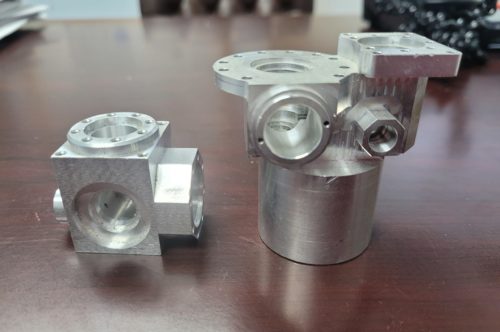 A good 3D model speeds up the programming process, especially for complex milled parts. Using the 3D model, we can export part data to our system and start running tool paths. If you don’t provide a 3D model, your manufacturing partner will need to create one. At Peerless Precision, we create models for our customers, but it does add to the total project lead time.
You’ll also need a 2D PDF drawing before your precision machine shop can begin prototyping. The PDF provides all the critical specifications for the prototype, including tolerances; materials; MIL-SPEC, AMS, or PSM spec requirements; and finishing processes.
2. Provide clear specifications and instructions
Use precise language in your PDF to minimize the risk of confusion or misinterpretation. For instance, referring to a material like titanium or aluminum too generally isn’t very helpful because there are dozens of grades and alloys, and they all have different properties. If you work with us and don’t have a material preference, state that in writing on your drawing. We’ll let you know what we select on your behalf.
There may be times when you don’t know the exact specs for what you need. In those cases, your manufacturer can probably point you to
subcontractors and share resources to help you make an informed decision. Just know that adding this step once you’ve initiated the prototyping process introduces a roadblock that can delay your project.
3. Anticipate changes
After the first prototype iteration is complete, expect a series of back-and-forth communications with your precision machine shop. At Peerless Precision, we send a customer their prototype so they can test it and adjust the design if necessary. Then, they send us the updated design so we can start working on the next iteration. It’s not uncommon to repeat this process several times.
We encourage customers to be highly responsive if they want their next iteration done quickly—standard lead times typically begin once a shop has your updated design in hand. The faster you test the prototype, adjust the design, and resubmit it, the faster the manufacturer can get to work.
4. Determine the quality you need at every phase
Choose a precision machine shop that delivers the quality you need at a cost you can manage. If you’re using your prototype to test for fit rather than function, you might not need an expensive prototype made to spec.
But if you’re looking for a high-quality prototype for testing fit, form, and function, you’ll want a precision machine shop that’s up to the task. Quality does come at a higher price, especially when dealing with low volumes, but chances are the cost per part will substantially decrease if you plan to enter production.
5. Think ahead to production
Do you know that you’ll be taking your prototype to production ahead of time? Many customers in this situation work with two different shops—one for prototyping and another for production. The drawback is that the production shop won’t know the ins and outs of your part, which can add time and cost to your project once it’s out of prototyping.
A better option is to select a precision machine shop that will grow with you from prototyping through production. They’ll already have all the operations and programs in place, which can save you time and money when your part is ready for production.
6. Reach out for help
If you outsource prototyping internationally, you may pay less for it, but you’ll likely have fewer opportunities to ask questions and may not receive prompt feedback—and in the prototyping world, those are significant losses.
When you work with the team at Peerless Precision, we’re a quick phone call away at all times, so you can easily reach out with any questions or concerns you have during prototyping. We’ll be in close touch with you, too, especially if we find ways to optimize manufacturability.
Looking for a precision machining partner who can work with you from prototype through production? Peerless Precision is here to fill that role and ensure a successful manufacturing process. Request a quote today to get started!
How Peerless Precision Leverages Vertical Integration for CNC Turned Parts
Comments Off on How Peerless Precision Leverages Vertical Integration for CNC Turned PartsDid you know that most lathe parts need secondary operations? CNC turning is usually the first stop on a longer machining journey that can require a wide range of capabilities.
If a machine shop doesn’t offer a full complement of secondary and finishing services in-house, they’ll have to outsource certain operations, adding cost and time to a project. So why not find a one-stop shop that does it all?
We leverage vertical integration principles at Peerless Precision, combining multiple capabilities under one roof to deliver high-quality turned parts complete and ready to go.
In-house Precision Machined Lathe Parts
CNC turned parts start in our lathe department, which includes 3 Okuma lathes and 2 Hyundai Kia lathes outfitted with bar feeders to maximize efficiency and cost-effectiveness for our customers. Our Kias can load up to 3″ diameter bar stock, and our Okumas can load up to 6″ diameter bar stock, both accommodating a range of quantities from a single prototype to mid-volume production orders of a few thousand parts.
But CNC turning alone can’t always achieve the high degree of precision or complexity our customers need. We leverage various secondary operations to satisfy stringent requirements.
We typically transfer turned parts to other departments, such as CNC milling, to machine ultra-complex features, like cut-out windows and shaft facets.
In our CNC Turning and Milling Departments, we can achieve tolerances of ± .0002″ and surface finishes measuring 16 Ra. When tighter tolerances and better surface finishes are required, we have grinding, honing, lapping, burring, and polishing operations available in-house that can produce tolerances as tight as a millionth of an inch, surface finishes down to 2 Ra, and flatness to 1 Helium Light Band.
Lathe Parts We Commonly Manufacture In-House
Interested in working with us for your lathe parts? We’ve assembled a list of components we frequently manufacture for aerospace and defense applications. (But if you don’t see your application here, rest assured we can probably still make the part you need!)
Aerospace components
- Matched sleeve and piston sets
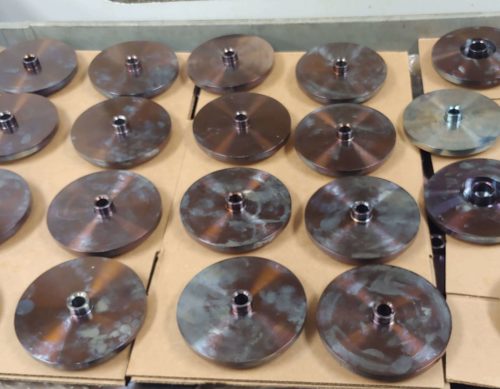
- Engine control components
- End cap housings for landing gear
- Shut-off sleeves for engine control systems
Commercial and defense optics components
- Lens housings for microscopes and 3D measuring systems
- Parfocal adapters for commercial optics
- Regenerator pistons and sleeves for camera systems
- Ryton tubes for cryogenic systems
- Stator housings for cameras
- Coldfinger weldments for defense optics and cryogenic systems (Fun fact: We make so many that we have a dedicated lathe just for these parts!)
In addition to aerospace and defense machining, we frequently turn specific medical components, like housings for cranial bone drills.
We have a broad range of capabilities for your lathe parts right here in our Massachusetts machine shop. And in the rare case that we can’t perform the operations your part requires, we’ll work with our trusted vendors and manage the entire supply chain, so you don’t have to.
When you need lathe parts, come to a true one-stop shop like Peerless Precision. Request a quote today!
Superior Tungsten Machining at Peerless Precision
Comments Off on Superior Tungsten Machining at Peerless PrecisionTungsten, one of the hardest elements in the world, is a reliable material for numerous manufacturing applications that encounter high-intensity environments.
Tungsten boasts the highest boiling point of all chemical elements, and with the second-highest melting point (after carbon), it’s capable of withstanding extreme temperatures up to 6,192 degrees Fahrenheit. It’s also naturally corrosion-resistant, repelling water and resisting most acids and bases.
In its purest form, tungsten is relatively malleable. But when combined with other elements, it becomes brittle and difficult to machine.
At Peerless Precision, we’ve worked hard to become tungsten experts and are excited to share some of our journey with you today. But first, we’ll break down everything you should know about tungsten machining.
Common Tungsten Applications
Over 100 years ago, William D. Coolidge first used tungsten filaments in incandescent light bulbs. Today, tungsten applications span a wide range of industries:
- Aerospace. Tungsten alloys composed of at least 85% tungsten offer impressive stabilization compared to other metals. Tungsten’s high attenuation properties lessen the physical impact of force, dampening vibration for aerospace machining applications like helicopter blades, aircraft ballast weights, and missile components.
- Electrical. Tungsten’s unrivaled heat-resistant properties make it an ideal choice for heating elements in electrical furnaces and other high-temperature applications. Tungsten also offers high electrical conductivity and can be used as a substrate in semiconductor rectifying devices.
- Medical. Due to its high density and attenuation properties, tungsten is an excellent material for medical machining applications like radiation shielding and diagnostic medicine applications like computed tomography, external beam radiotherapy, and x-ray imaging.
- Military and defense. Tungsten’s ultra-tough composition is well suited for projectile penetration applications like shrapnel heads and missiles used to breach armor. Tungsten alloy bullets are commonly used in large-caliber shelling, offering solid compression and deformation resistance.
Challenges of Machining Tungsten
Hard and brittle materials like tungsten are known for being difficult to cut. Tungsten machining can take years of trial and error to get right, requiring rigid fixturing and minimal spindle runout. Only the most skilled machinists have what it takes to machine it effectively.
Tungsten can be forged, drawn, extruded, or sintered, but no matter the manufacturing method, the tooling must be strong enough to withstand its incredible hardness. To minimize tool breakage and ensure a long tool life, we carefully research all tungsten alloys before machining so we know the optimal tooling to use. This process includes working closely with our tooling vendors and their representatives to identify the best tooling for the application and material we’re working on. Preserving the life of our tooling allows us to maintain reasonable costs and lead times for tungsten projects.
Careful adjustment of feeds and speeds is required during tungsten machining to balance tool health and machine time. If tungsten is machined too quickly, the tooling could break or damage the part. If it’s machined too slowly, the process is inefficient and costly. Experienced machinists can pinpoint the Goldilocks speed that’s just right.
Peerless Precision Journey to Becoming Tungsten Experts
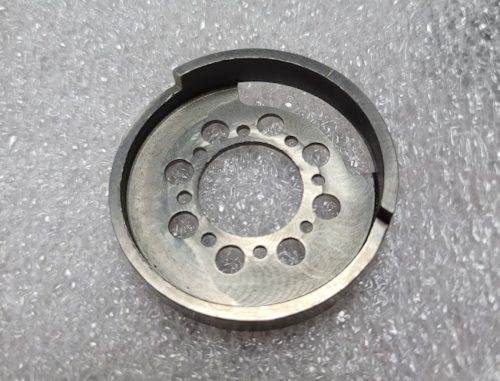
At Peerless Precision, our dedicated research and development process and unwavering commitment to quality have helped establish us as tungsten machining experts.
In our early days of tungsten machining parts for a major customer, we discovered that the first of two CNC milling operations we had been performing went smoothly, but the second produced parts that cracked when flipped over. The parts continued to crack even more when we passed them through cylindrical grinding.
Determined to find a solution, we went back to the drawing board. We reviewed our programming and processes to figure out how to reduce cracking—but nothing seemed to work.
We decided it was time to evaluate the material itself and learned that using a purer and less brittle form of tungsten was the solution we had been looking for. This high-quality tungsten would maintain its hardness properties and be malleable enough to machine effectively.
Sourcing the perfect tungsten was no easy feat. We tried 5 different mills before finally finding the winner: Federal Carbide Company, a Pennsylvania mill that sources tungsten domestically. Cracking was less of an issue once we started using their tungsten, and our scrap rate dropped from 30% to 2%! We now source all of our tungsten from this trusted supplier—and our customers reap the benefits.
We’ll stop at nothing to get you the parts you need. If you’re looking for tungsten experts for your next project, look no further than Peerless Precision. Request a quote today!