Comments Off on 5 Reasons Our AS9100 Machine Shop is an Ideal Aerospace Partner
The heart of aerospace manufacturing is known as Aerospace Alley–an area of the United States that encompasses the southwest Massachusetts and northeast Connecticut region. From this hub, our AS9100 machine shop proudly machines complex parts that help put planes in the sky.
Peerless Precision has been a trusted aerospace machine shop in Aerospace Alley for four decades, and aerospace machining comprises over 50% of our work. Our Westfield, MA company plays a pivotal role in the larger supply chain, crafting vital components to join with larger assemblies from other shops in the area.
The Critical Role Peerless Precision Plays in Aerospace Alley
Nearly every plane or helicopter soaring through the clouds carries a piece that was manufactured in this region, with each aircraft boasting at least $200,000 worth of parts crafted in Aerospace Alley—including parts from our precision machine shop.
In our 40 years serving the aerospace industry, we’ve grown and evolved to meet the industry’s demands and continually exceed quality expectations.
Here are five ways we stand out among aerospace machine shops:
1. One-stop shop services
Peerless Precision is a one-stop shop for all your aerospace machining needs. From CNC milling and turning to lapping and honing, we perform all operations in-house, ensuring a seamless and controlled manufacturing process.
Thanks to our range of capabilities, we can control costs and consolidate vendors to provide the best service to our aerospace customers.
2. Rigorous certifications
Our AS9100D and ISO 9001:2015 certifications reflect our dedication to meeting the highest aerospace industry standards. We maintain these certifications via yearly surveillance audits and external audits every three years.
But that’s not all. Peerless Precision is also ITAR registered for our military and defense customers. Additionally, our compliance with Cybersecurity Maturity Model Certification (CMMC) ensures the safeguarding of proprietary information, offering our aerospace partners peace of mind in an increasingly digital landscape.
3. Finishing services
Our attention to detail sets us apart, and you’ll see this attention to detail reflected in our finishing services.
Finishing services are just as important as machining, as these services can enhance surface properties such as adhesiveness, electrical conductivity, wear resistance, corrosion resistance, and frictional resistance.
We can perform grinding, honing, lapping, and more. These capabilities enable us to achieve tolerances that are unachievable with CNC machines, from +/- .0001” down into the millionths of an inch.
4. Low-volume specialization
Our specialization lies in low-volume, critical components. We found our niche early on and focused our resources on developing our low-volume and custom capabilities.
Compared to larger aerospace shops that can “do it all,” we work on more customized, niche parts with a level of precision you can’t find anywhere else in Aerospace Alley. Customers come to us not only because of what we do but what others can’t do.
The Peerless Difference: Why Aerospace Comes to Us
Peerless Precision is a proud member of Aerospace Alley. Our focus on low-volume, custom work and our one-stop-shop capabilities empower us to take on projects that our competitors can’t.
As we continue to grow, we will keep elevating our aerospace machining capabilities, contributing to the innovation that propels the aerospace industry into the future.
Request a quote to work with our peerless aerospace machine shop.
Comments Off on How Our Collaborative Approach to Precision Machining Benefits You
In our industry, there is a common disconnect between design and manufacturing. As a result, we often receive part designs with over-engineered or impractical features—for example, unreasonably tight tolerances or unnecessarily strict plating specifications that will increase costs and lead times without any significant benefit to the part’s function.
As a build-to-print precision machine shop, we are dedicated to manufacturing the. That said, we are also always on the lookout for opportunities to save you time and money, and often that means speaking up to offer our expert opinion and collaborate with you to achieve optimal results.
Collaborating with Customers to Achieve Optimal Results
Working with our MA machine shop isn’t just an exchange of goods and services–it’s a partnership based on mutual success. As your precision machining partner, we’re determined to communicate with you to deliver the best parts possible.
Our experienced team of machinists understands the principles of Design for Manufacturability (we even wrote an eBook on it) and can suggest design modifications that result in cost savings and faster, more efficient manufacturing.
We’ll combine our precision machining expertise with your engineering knowledge to optimize your part. Our naturally inquisitive team asks questions like, “Why did you design these tolerances so tight?” and “Is there another way we can achieve this result?” We value knowing the “why” behind your design so we can make time and cost-saving recommendations.
In short, we view communication and collaboration as critical aspects of the manufacturing process and hope you do, too.
When we receive a prototype design, we build it to the initial specifications and determine whether the form, fit, and function fulfill our customer’s requirements. If not, we identify areas for improvement. This iterative process continues until our customer is satisfied and we deliver the best part possible.
Once the part reaches production, it’s a seamless transition because our team knows the part, our machines are already programmed, and we’ve done the upfront work to optimize the design for manufacturability.
Case Study: Our Collaborative Precision Machining Approach in Action
Recently, one of our defense customers wanted a new version of a part we’ve been making for them for 10 years. We manufactured the old version from aluminum, but the customer wanted us to make the new ones from tool steel.
However, the part is heat treated, and the combination of heat treatment and roughing out the part on the mill distorted the tool steel. So, our foreman reviewed the design with the customer to find a solution.
In the conversation, we learned that several dimensions and tolerances weren’t necessary for the part’s function. By knowing what tolerance and dimensions had a little wiggle room, we could manage the distortion to not affect the fit and function of the part.
This back-and-forth exchange is just one example of our collaborative approach at Peerless Precision. We strive to produce parts as close to perfect as possible, and we always include the customer in that conversation. It’s your part, after all!
Partner with Peerless Precision for Headache-Free Parts
We strongly believe that customers deserve a precision machining partner who relieves headaches—not one who causes them. We strive to be that shop for you by keeping an open line of communication and sharing recommendations for optimizing your part whenever possible.
When you partner with Peerless Precision, you work with a machine shop that has your best interests at heart. We’re not just going to deliver what you ask for but what you deserve—the very best.Ready to get started? Request a quote today.
Comments Off on Why Manufacturing Leaders Must Invest in Workforce Development
The manufacturing industry is facing a workforce development crisis.
A study conducted by the Manufacturing Institute and Deloitte estimates that by 2030, 2.1 million manufacturing jobs could go unfilled if more people aren’t inspired to pursue modern manufacturing careers.
The shortage could cost manufacturers $1 trillion in 2030 alone.
That’s why Peerless Precision’s president, Kristin Carlson, is investing her time and money to create opportunities for Western Massachusetts youth to discover a different, exciting side to manufacturing.
Her story uniquely positions her to be a force for change as she works to change the narrative around technical schools and careers in the manufacturing industry.
After all, Kristin wasn’t always the president of a multi-million dollar MA machine shop and the Western MA NTMA chapter.
She had to take the long way to get there.
The Long and Winding Road to Precision Machining
Kristin didn’t plan on pursuing a manufacturing career.
Sure, manufacturing was the family business. Her father, Larry Maier, bought Peerless Precision when she was a sophomore in high school. All the tell-tale signs of a future machinist were there: she loved shop class, home economics, art—anything that let her work with her hands.
Plain and simple: Kristin loved making stuff.
But when it came time to cement her plans after high school, Kristin’s father was adamant that his kids go to college—not technical school. It’s ironic, considering he was the owner of a machine shop.
Kristin enrolled in a business administration program, but lectures, textbooks, and passive listening didn’t work for her. She learned by doing—she wanted to get her hands on something and figure it out.
“I went to college because everyone told me I was supposed to,” said Kristin, “not because I wanted to.”
So she dropped out.
Rewriting the precision machining narrative
As Kristin moved into the working world, she held several roles and even worked as a buyer for a fire alarm contractor. However, the pressure of other people’s expectations and the stigma around technical vocations like manufacturing followed her.
When her journey brought her back to Peerless Precision, Kristin found herself in a position to start changing the narrative around manufacturing jobs. She joined the leadership board of her local NTMA chapter and began searching for ways to invest in the local workforce in her community.
“My goal is getting the next generation of students interested in what we do,” Kristin said. “We need to change the negative perception of the manufacturing industry and show students how awesome it is to make stuff for a living.”
Industry Leaders Must Invest in Workforce Development
Kristin often uses a fishing metaphor to describe the future of the manufacturing industry’s workforce:
“We’ve got this small pond with a limited number of fish that we’re all fishing from,” Kristin explained. “If we don’t start putting fish back in there, what will happen? We have to find a way to boost that population.”
In recent years, the emphasis on standardized test scores and increasing college enrollment came at the expense of hands-on classes like shop, home economics, and art. Meanwhile, the message from many teachers, parents, and guidance counselors remains: vocational jobs are the ‘lesser’ choice.
Many kids have lost the chance to discover the joy of making things with their own hands—and the realization that, yes, you can make a living doing just that.
Investing in manufacturing workforce development is pretty simple for most shops: all you have to do is find a way to empower and enable young people to create. Whether that’s donating to a local innovation center, hosting a field trip at your machine shop, or offering apprenticeships to high school students.
It’s time for manufacturers to take matters into their own hands and repopulate the pond.
How Workforce Development Helps Shops
When shops invest in workforce development, they benefit just as much as the people they’re inspiring. For example, these investments are a great way to combat employee shortages and pull ahead of the competition.
Thanks to Kristin’s investments in her community and demonstrated commitment to the future of manufacturing in Western MA, she never has to look too far when hiring a new Peerless employee.
“When I’m part of the change, I am the first one schools reach out to,” Kristin said. “When they have students looking for co-ops or internships, or if there’s a training program in our region for unemployed and underemployed adults, they reach out to me and ask, ‘Who do you want to take?'”
But for Kristin, workforce development is about more than just bringing new people into manufacturing. She’s ready to shape them into the best machinists—and people—that they can be.
“In every job I had before I started running Peerless, my employers always saw things in me that I didn’t see in myself,” Kristin said. “They gave me opportunities to become more than the college dropout that I was. And now, I’m paying it forward.”
Workforce Development Investments in Action
Here’s how Kristin and the Peerless team have recently invested in their community:
Funding the local Junior Achievement center
In October 2023, Kristin used her late father’s memorial education fund to sponsor the building of a Career, Innovation, and Leadership Center at their local Junior Achievement Center.
The new center promises exciting opportunities for students outside of a traditional school curriculum. One of the center’s standout features is the manufacturing room, a tribute to the robust manufacturing heritage in Western Massachusetts.
The fund sponsored a Cricut machine and the Cricut starter bundle to empower kids to start making things for themselves. In the future, Kristin hopes also to sponsor a 3D printer and a mini-mill machine to bring tangible machining tools to the center.
“I’m always happy to support initiatives like the JA center,” said Kristin. “It warms my heart to see my father’s fund help make this innovation center possible.”
Speaking on a panel at MA Tech Collaborative
Investments don’t always have to be financial—manufacturing leaders can offer their time, too.
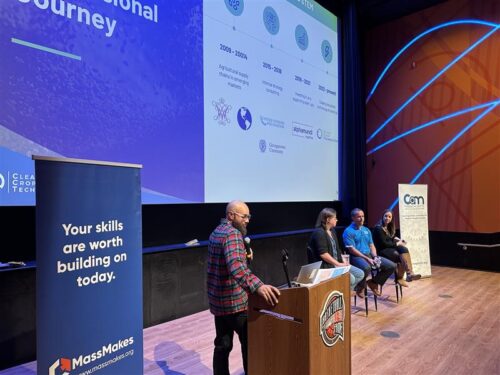
Kristin recently spoke on a panel at the MassMakes Innovation Challenge, whichcombined hands-on manufacturing, engineering projects, and Q&A sessions with industry leaders. Over 300 students from across Western Massachusetts attended and heard Kristin speak about her non-traditional journey to precision machining.
“After the panel, students asked us for advice that we wish we’d gotten when we were students,” Kristin said. “I said, ‘Look, have fun. You have to be able to laugh at yourself and realize that nothing is a straight path.
“It’s okay to take the long and winding road to find out where you’re supposed to be.”
Workforce Development Is Our Responsibility—Let’s Act Like It
In manufacturing, change often starts at the top. It’s up to the presidents, CEOs, and VPs to do the legwork and usher in the next generation of manufacturers and machinists.
“As industry leaders, investing in workforce development is our collective responsibility,” Kristin said. “You can either sit back and wait for someone else to do it, or you can be part of the change.”
Comments Off on How Our Inspection Process Promises Quality Precision Machining
In the precision machining world, there’s little room for error. Whether manufacturing a lens housing for an optics customer or a plastic piston ring, we’re committed to delivering quality at all times.
Peerless Precision’s rigorous inspection process—run by an experienced team using top-tier equipment—ensures customers always get what they ask for.
To achieve truly peerless results, our inspection starts when we receive a purchase order and ends when parts leave our shop. As an AS9100 machine shop, we maintain AS9100 quality standards, whether or not parts require it.
Because to us, quality isn’t just a buzzword. It’s a promise.
Our 6 Stages of Inspection for Precision Machining
We implement six inspection checkpoints to guarantee part quality. It’s not enough for parts to meet the minimum requirements—we’re determined to exceed customer expectations.
Here are the six stages of our inspection process:
1. Purchase order review
We thoroughly inspect each PO to ensure all customer needs will be met and parts are designed for efficient manufacturing. Our engineering, quality, and production department leads sign off on POs before production begins.
2. Material certifications
Our inspection department reviews raw material certifications to ensure the grade, composition, and relevant specifications match the customer’s request. We call the material supplier to request a replacement if we receive raw material that doesn’t meet all the criteria.
3. First part approval
We check the first part we’re precision machining after each operation to ensure measurements align with the design specifications. If the measurements match, the operator continues manufacturing parts. If not, we repeat the process until we get the measurements correct. Machines are calibrated yearly on a rotating basis to ensure tools remain accurate.
4. In-progress checks
As parts run through machines, operators measure the most recent machined parts to ensure correct measurements. Machines can quickly go out of tolerance, and by checking consistently throughout the order, we can catch errors before a whole order is compromised.
5. Specialized treatment evaluation
Our inspection team measures parts before and after sending them to a third-party vendor for a specialized process like heat treating or plating. We also check treatment certifications to verify the processed parts meet customer specifications.
6. First article inspection report
We inspect 100% of the parts made for first-time part orders to provide a first article report. Customers receive an in-depth report containing the dimensions of every part in the order, which they check against the received parts. When customers repeat part orders, we only inspect a sample of the final parts. The customer dictates the sample amount.
The Inspection Tools of an AS9100 Machine Shop
One of our shop specialties is achieving minuscule tolerances ranging from 0.0001” to 0.000005.” But with such small measurements, there’s hardly any room for error. A variance of even 0.005” can cause parts with tight tolerances to fail.
That’s why we rigorously inspect part tolerances using our wide range of tools, from standard gauge blocks to cylindricity measuring machines. We regularly invest in the newest technology to better serve our customers.
Here are some of our state-of-the-art inspection tools:
Air gauging equipment for inspecting inner diameters
Laser micrometers for performing precise measurements up to six decimal places
Keyence instant measurement systems to speed up the inspection of priority parts by generating 99 measurement points in 3.5 seconds
Cylindricity measurement machines to verify precise part roundness
Regular equipment calibration
At Peerless Precision, we calibrate our tools every year to maintain their accuracy. We schedule calibrations on a rotating basis to ensure we can still complete orders in a timely manner.
Quality People Are the Key to Success in Precision Machining
Behind our advanced, finely calibrated machines is a team of experts. We hired dedicated, seasoned inspectors to ensure we live up to the name “Peerless Precision.”
Our quality manager has over four decades of experience in quality assurance for manufacturing, and our lead inspector brings 30 years of experience. The rest of our team benefits from the guidance of these two industry experts.
Delivering quality parts to quality people
Our in-depth inspection process goes above and beyond to provide exceptional parts to customers. Combined with our dedicated team and state-of-the-art equipment, we do more than manufacture—we perfect.
Comments Off on Why Machine Shops Should Build a Network with Each Other
No machine shop wants to turn away customers. However, if the work is beyond a shop’s capabilities, it’s not good business practice to take the job and deliver subpar results.
Fortunately, there’s a third option—one we frequently turn to at Peerless Precision: collaboration between shops. When shops collaborate, we can build partnerships that work off each other’s strengths and manufacture high-quality parts—no matter the requirements. Everyone wins.
Keep reading to find out how we support other shops—and when we know it’s time to reach out and call on other shops for their support.
How Peerless Precision Supports Other Machine Shops
Shops often call on Peerless Precision for our expertise in manual machining methods and finishing processes, tight tolerance parts, prototypes, and low-volume orders.
Manual machining methods
The machinists at Peerless Precision are experts in manual machining—a skill that’s becoming more difficult to find. While budding machinists are taught manual methods initially, they soon move on to CNC machining. This transition leaves little time to develop the feel of manual machining, which can take years. We continuously train our machinists on manual methods so we can perform this type of work for our customers.
Manual machining has many advantages, including short turnaround times. The process involves fewer steps than CNC methods and requires no programming. Manual machining is also ideal for smaller projects, a major focus area for our shop.
Tight tolerances for defense and aerospace machining
A part is considered to have a tight tolerance when its permitted variance is plus or minus 0.002-0.001”. Even a slight variance of 0.005” can lead to part failure and potentially result in severe damage. With our expertise, our team can achieve tolerances from 0.0001” to 0.000005”—a range often required for medical, aeronautics, and aerospace machining.
Prototypes and low-volume orders
Some job shops turn down orders for five, 10, or 25 parts because they prefer high-volume work involving thousands of parts. However, our machinists have decades of experience focused on prototypes and low-volume production. Our problem-solving and critical-thinking skills allow us to build partnerships with our customers to meet their small order needs with quality, efficiency, flexibility, and speed.
Manual finishing processes
Our shop specializes in cylindrical grinding, lapping, and honing. We work with two different honing technologies, including our Sunnen ML-4000 machine. We also have two types of lapping capabilities: match lapping and roll lapping. These manual finishing processes are ideal for high-precision parts common in medical, optical, defense, and aerospace machining.
When We Seek Outside Support from Other Shops
We reach out to our network of precision machining partners for several reasons. Sometimes, a piece of material may be too big for our machines, so we contact another shop that can handle it. Other times, capacity becomes an issue. We may subcontract mill and lathe work to another shop when we see a bottleneck brewing.
With this flexibility, we can ensure our customers get the parts they need when they need them. Working with other shops also improves our ability to control costs—though that’s been challenging in the past few years because of supply chain issues and cost increases across the board in areas like utilities, labor, and materials.
While we enjoy working with other businesses, not every precision machining shop is willing to join forces. They worry another company will steal their customers. But we believe churn won’t be an issue if you provide excellent service. It’s all about trust. We work with shops we know and have good relationships with to fill each other gaps and keep customers in the region.
And that starts with identifying the right material for your application. If you don’t do your homework, you could end up with unsatisfactory results.
Use these four blogs as your resources to understand the differences between popular materials and the types of applications each material is best suited for.
1. Is A286 Stainless Steel Right for Your Application?
A286 stainless steel is a precipitation-hardenable superalloy that’s challenging to machine. It’s commonly used for parts such as bushings, gas turbines, and screws. The benefits of A286 stainless steel include strength, corrosion resistance, and non-magnetic properties. Drawbacks involve weight, sourcing, and cost.
Our shop knows A286 machining is an essential service for our customers. Over the years, we’ve learned how to make the process as efficient and cost-effective as possible.
2. Superior Tungsten Machining at Peerless Precision
Tungsten, one of the most resilient elements worldwide, is a dependable material for various manufacturing applications that confront intense environments. With the highest boiling point among all chemical elements and the second-highest melting point (surpassed only by carbon), this material can withstand up to 6,192 degrees Fahrenheit.
Our team has worked hard to become experts in tungsten machining because of its suitability for American defense manufacturing. It requires exceptional expertise for machinists to handle this material effectively.
Titanium is ideal when durability and exceptional fatigue life are crucial for your parts. This versatile material has a remarkably high tensile strength-to-weight ratio, weighing half as much as stainless steel and nearly 30% stronger. Titanium is also renowned for its resistance to rust and corrosion.
Peerless possesses the capabilities, equipment, and personnel to tackle the most challenging titanium jobs. Typical applications include medical, aerospace, automotive, defense, water and energy, and commercial optics.
4. Peerless Precision Specializes in Invar Parts for Optical Machining
Finding a shop that will quote parts made from Invar can be challenging. This material is a nickel-based non-magnetic alloy with a multitude of beneficial properties. Invar is resistant to temperature variations, weather conditions, and corrosion.
Invar parts used in commercial optics and optical machining must be flawless. Our shop takes extra precautions—such as implementing additional QA measures and using special shipping materials—to ensure your parts are pristine when you receive them.
Materials Matter: Understand Which Material Your Part Requires
Knowing which type of material best suits your part is one of the most critical steps in aerospace, medical, commercial optics, and American defense manufacturing.
Once you’ve identified the right material for your needs, our team of experts can machine that material and provide you with the highest-quality parts. And if you need additional support we can’t provide ourselves, our MA machine shop can set you up with one of our suppliers to offer guidance.
Request a quote for our custom CNC milling and turning services today.
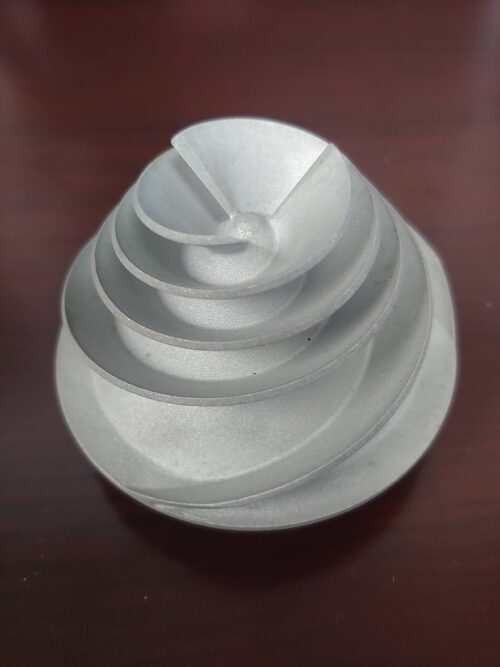
Are you considering castings for your next part order?
Depending on your needs, hogouts—parts machined out of a solid block of material—could be a better solution.
Keep reading to learn the pros and cons of castings and why our AS9100 machine shop leans toward precision machining hogouts.
Castings vs. Hogouts: How Each Process Works
Casting is a manufacturing process that creates parts in near net shape (NNS). In other words, the part is as close in size and shape to the finished product as possible.
During casting, molten metal is poured into a mold, where it solidifies into the shape of the mold. The process typically involves these steps:
Pattern creation
Mold making
Molten metal pouring
Solidification and cooling
Removal and finishing
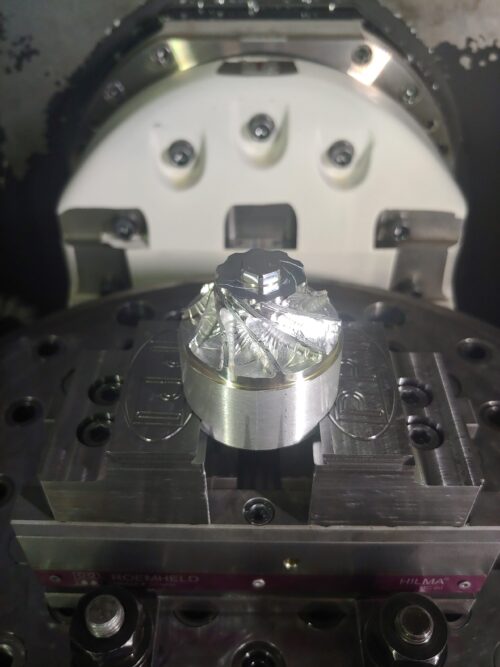
Creating a hogout involves removing material from a solid block to achieve the desired form. The process typically involves these steps:
Material selection
Workpiece preparation
Rough machining
Semi-finishing and finishing
Inspection and quality control
Additional operations
Both processes can produce quality parts. So, which one is better? Let’s examine some of the pros and cons of castings compared to hogouts.
The Pros of Castings
Less material waste
When a casting is complete, there’s no leftover material. The exact amount of metal needed to fill the mold is used to create the part. Since the precision machining process used to create a hogout is subtractive, more material is required.
Reduced precision machining time
Castings require significantly less precision machining than hogouts. By the time a casting reaches our AS9100 machine shop, most of the work is done because the base shape has already been achieved.
No need for assembly
Sometimes, a part needs to be assembled from more than one hogout. With casting, it’s possible to consolidate multiple pieces into just one.
The Cons of Castings
Longer lead times
Ongoing issues like supply chain disruptions and the manufacturing labor shortage are delaying casting orders. It used to take 3-6 months to get molds. Now, it can take a year or more.
Quality issues
Castings are prone to quality issues you don’t have to worry about with hogouts. With a casting, we could be 95% done with post-casting precision machining operations and have to scrap the part because of an air pocket. There may also be divots on the part’s surface that precision machining cannot fix.
What to Do When You Need Castings
If you’re intent on getting castings, our AS9100 machine shop is happy to work with you on your project. We simply like to be transparent about the issues that can arise when choosing this route. If possible, we ask that you supply us with the casting that you need machined. However, once you have chosen and approved a casting supplier, we can manage the purchasing process from the designated supplier.
Even better: consider modifying your part design to transition from castings to hogouts. We always prefer to machine parts from solid materials and find that hogouts are much more consistent in quality than castings.
Looking to the Future…
One of the most exciting things about manufacturing is that it’s always evolving. In the future, additive manufacturing may be an alternative solution to castings and hogouts.
Our team uses plastic 3D printers at Peerless Precision, but the technology isn’t quite there yet for it to offer a viable alternative to castings and hogouts.
For now, we’re happy to discuss your casting or hogout needs. Request a quote from our AS9100 machine shop today.
Comments Off on Plastic CNC Machining Services at Peerless Precision
Have you been turned away by job shops that avoid machining plastic?
Many shops will only work with metal because plastic can clog up machines. Moving metal through the coolant system and filters is a much cleaner process.
At Peerless Precision, we’re happy to discuss your plastic machining needs. We have a filtering system to prevent clogging and machines dedicated to plastics. And we’re always up for a challenge!
Here are some common materials we use when providing plastic CNC machining services and a quick look at their benefits and applications.
Onyx™
Onyx™ is a micro carbon fiber-filled nylon. This strong, tough, and chemically resistant material can be reinforced with continuous fibers to produce aluminum-strength parts. We use a 3D printer to create parts from Onyx, then finish them using CNC machining processes. Common applications include plastic part replacements, housing, sensor mounts, and cosmetic prototypes.
G-10
G-10 is a glass-epoxy laminate known for its exceptional strength and high dimensional stability over temperature. It has a high level of electrical insulation and a low water absorption rate. G-10 is durable, affordable, and easy to work with. Typical applications include terminal boards, high humidity applications, electrical and electronic test equipment, and electric rotor insulation.
Vespel®
Vespel® is a high-performance polyimide resin. This material can withstand extreme temperatures (hot and cold) and is often used in high-heat conditions where thermoplastics lose mechanical properties. Vespel has a low and consistent thermal expansion coefficient and excellent creep characteristics, allowing parts to be machined to tight tolerances. Common aerospace and space applications include bearings, bushings, valve seats and seals, and thermal isolators.
Polyurethane
Polyurethane is a material made from polymers and urethane. It’s resistant to abrasion, heat, solvents, oil, and acid. We generally order polyurethane in 3’-12’ round bars, which we run through our lathe and finish with a precision toolroom lathe. Since polyurethane is excellent for high-load and high-stress environments, typical applications include conveyor belt systems and aerospace components such as sleeves.
Ryton®
Ryton® is a high-performance thermoplastic that’s resistant to high temperatures and chemicals. It has high dimensional stability, which offers a rigidity that other plastics don’t. Ryton is flame retardant and high-stress cracking resistant. Common applications include electronics, automotive, aerospace, and chemical.
Rulon®
Rulon® is a low-friction, self-lubricating plastic. It has excellent abrasion resistance and can be used in a wide range of temperatures (-400 degrees Fahrenheit to 550 degrees Fahrenheit). We primarily use Rulon J in two different forms: bars and sheets. However, we have access to all grades. Typical applications include seals, piston rings, and bearings.
PEEK
PEEK is a high-performance plastic that’s highly resistant to harsh chemicals. It’s also hydrolysis resistant to steam, water, and seawater. PEEK maintains stiffness at high temperatures and can withstand environments up to 338 degrees Fahrenheit. Common applications include space, aerospace, oil and gas, food and beverage processing, and semiconductor.
Get the Parts You Need with Our Plastic CNC Machining Services
Are you looking to create a prototype? Plastic can be a great alternative to metal during prototyping. Although a plastic prototype won’t function like the final metal part, you’ll have the opportunity to test fit and form quickly and cost-effectively.
Whatever your project requirements, our machine shop in MA will work with you to make the parts you need from your desired materials. Request a quote for our plastic CNC machining services today.
Comments Off on A One-Stop Shop for Prototypes and Low-Volume Production
Has a job shop ever turned down your order because you only needed 10 parts—not 10,000?
You’re not alone.
Our team talks with many prospective customers at networking events and trade shows. One point of frustration that comes up over and over again is that businesses struggle to find a manufacturing partner to take on orders of five, 10, or 25 parts because most shops only want high-volume work.
We assure these prospective customers that Peerless Precision will never no-quote small-quantity jobs. In fact, prototyping and low-volume production are our specialties, and we’ve excelled at these projects for years.
When our prototype machine shop works on a small order, we can build a partnership with the customer and learn the best way to support their overall manufacturing needs—a winning situation for everyone involved.
3 Reasons to Work with Peerless Precision for Prototyping and Low-Volume Production
Our prototype machine shop has the passion and expertise to take your project from prototype to low-volume production. Here are some of the advantages of working with our team:
1. Quality and efficiency
Prototyping is a challenge our shop enjoys. We know the first version will never be the last. This intimate, repetitive process allows our team to work with a customer through several iterations to create the highest-quality part.
When it’s time to move from prototype to low-volume production, the transition is seamless and efficient because we’ve already solved the design challenges and know the part well.
2. Flexibility and speed
Low-volume production keeps Peerless Precision team members on their toes. Taking on small-quantity orders one after the other creates agility and flexibility, improving our ability to meet customer requirements and delivery schedules.
Since a single part doesn’t tie up our machines for six months, we can easily find a spot in the schedule to fit in the next job.
3. Intellectual property protection
Prototyping requires access to a customer’s intellectual property (IP). Protecting this sensitive information is a responsibility our AS9100 and ISO-certified machine shopdoesn’t take lightly. We adhere to high standards to secure your IP.
For instance, we only allow authorized team members to see your prototype information. If an employee isn’t directly involved with your project, they don’t get access to the prints.
Your One-Stop Prototype Machine Shop
Some customers want to get prototypes and low-volume parts the fastest and cheapest way possible. Unfortunately, rushing the process often means bypassing critical steps, which can result in low-quality parts. Remember: it’s almost always more expensive to rework parts than to get them right the first time.
If you want top-quality prototypes optimized for manufacturing, work with a prototype machine shop like Peerless Precision. With decades of experience specializing in prototypes and low-volume production, we’ve developed strong problem-solving and critical-thinking skills that enable us to provide optimal value to our customers.
There’s very little we can’t do—and in the rare event that we don’t feel confident about a project, we’ll be honest with you about it up front.
Comments Off on How Peerless Precision Facilitates Flawless Anodized Finishes
Anodizing is a common finishing service that many customers request from our AS9100 machine shop.
The electrochemical anodizing process applies an anodic oxide finish to the metal surface of parts made from aluminum or other nonferrous metals to enhance corrosion resistance, durability, and aesthetic appearance. Standard anodizing types include Type I-Chromic Acid Anodize, Type II-Sulfuric Acid Anodize, and Type III Hard Anodize.
Customers typically request anodizing for two reasons:
To protect a part’s surface from the effects of harsh weather, salt, temperature extremes, and other environmental factors.
To provide an aesthetically appealing coating. Anodize is available in a wide variety of beautiful colors.
Anodizing is a specialty service that Peerless Precision outsources to trusted plating vendors. When a customer needs this service, we project manage the entire process, maintaining open communication with the customer and the plating shop to ensure high-quality results.
A Network of Trusted Anodizing Vendors
Our AS9100 machine shop has a network of approved vendors who we trust to anodize parts to our high standards. Due to the size of this network, we have the opportunity to select the vendor best suited for each customer’s anodizing specifications.
Many of our defense and aerospace machining customers must verify that a plating shop meets specific criteria before we can send parts for anodizing. We’re happy to work with plating companies to obtain these customer approvals when necessary.
Maintaining Our High Standards
Anodizing draws out any flaws on the material’s surface. Even the slightest fingerprints could become permanent eyesores after the finish is applied. This issue is most prevalent with clear or light-colored anodized finishes.
To proactively avoid receiving parts from anodizing vendors that don’t meet our standards, our team is strict about how vendors handle our customers’ parts. For example, we only work with plating houses whose employees wear cotton gloves on top of nitrile gloves. Doubling up on gloves prevents fingerprints from “sweating” through and affecting the part’s surface.
Our shop also performs annual quality surveys with each vendor as part of our ISO 9001:2015 and AS9100 certifications. We assign quality and on-time delivery scores to ensure our anodizing partners continuously meet our high standards.
Most importantly, we approach vendor relationships collaboratively and communicatively. We’re fully invested in our vendors’ success because if one of us fails, we all fail (our shop, our vendor, and our end customer).
If you need an anodized finish for your parts, you can trust Peerless Precision and our vendor network to deliver. Request a quote from our AS9100 machine shop today.