When Does a Part Need 5-Axis Machining? Choosing the Best Process for Your Parts
For many years now, Peerless Precision has offered 5-axis machining for complex, challenging parts. But we don’t send every milling project to our 5-axis machine; instead, we’re always searching for the most efficient, economical choice for our customers.
Learn where 5-axis thrives and how our team evaluates each precision machining project to select the right process without increasing cost.
The Benefits of 5-Axis: Reduced Setups and Cycle Time
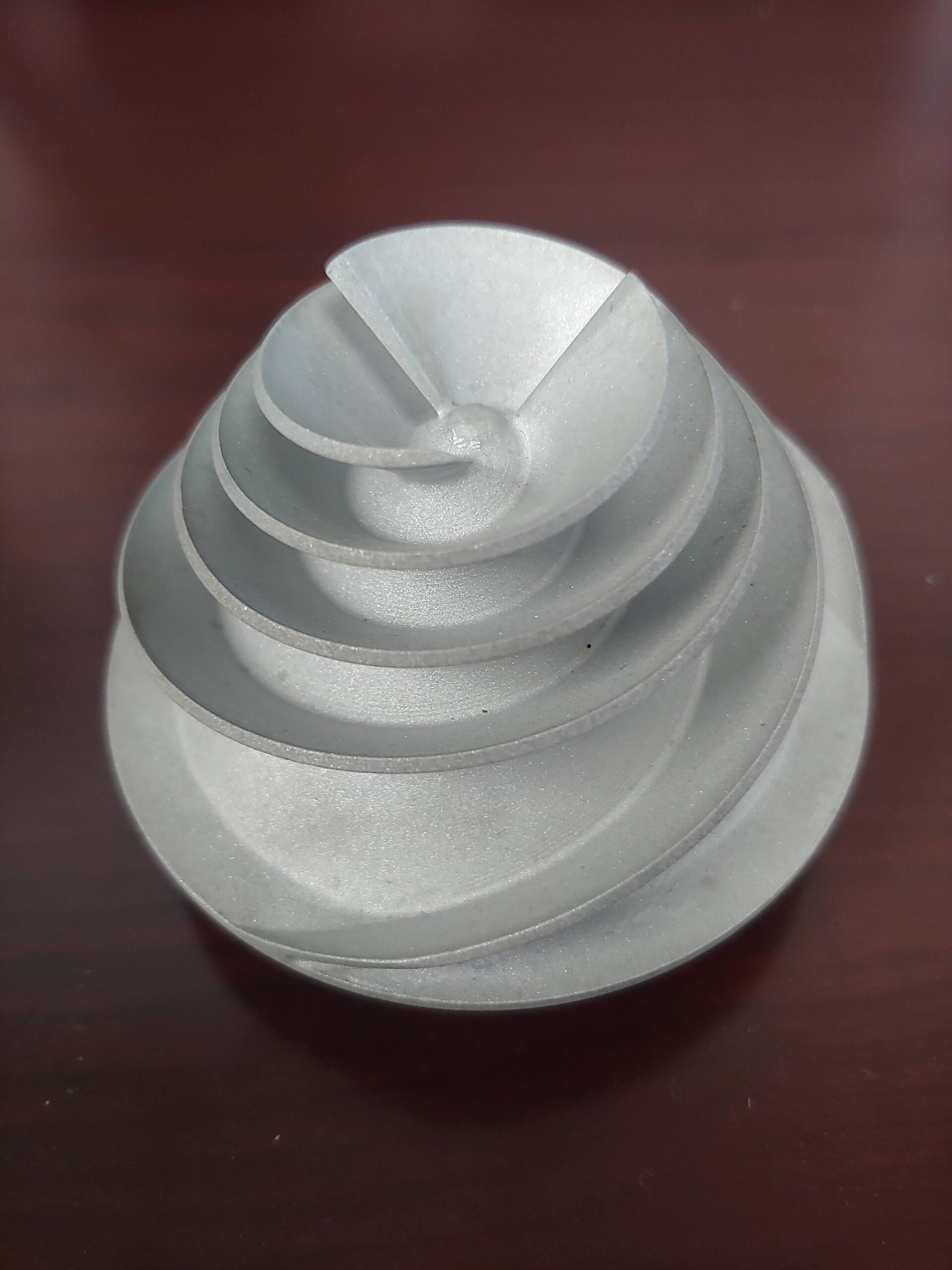
Compared to 4-axis machining, a 5-axis machine adds additional axes of motion, allowing the cutting tool to approach the workpiece from more angles, often with simultaneous multi-axis movement.
A part requiring two to four operations on a 4-axis machine may need only one or two on a 5-axis machine, and the fewer setups lead directly to less handling and fixturing. Depending on the component, machining time can go down by as much as 50%.
These capabilities have allowed us to use 5-axis machining for complex parts like crankcases, impellers, and countless others.
3 Signs a Part May Need 5-Axis Machining
The best method depends on the part, but when we first see a design, three factors are indications that 5-axis may be the right choice:
Tolerance requirements: Our 5-axis machine can hold tighter milling tolerances than our 4-axis equipment. A part may be simple enough for 4-axis machining based on its shape, but could still require 5-axis machining due to its tolerances.
Part complexity: Components with intricate contours, numerous features, or complex geometries are likely candidates for 5-axis machining. Reaching multiple surfaces without repositioning again and again helps us produce these features efficiently.
Part configuration: A flat pump cover or a sleeve requiring only a drilled and tapped hole may be ideal for 4-axis machining. But a complex crankcase machined from a solid block could require substantially more time and fixturing without 5-axis capability.
How a Crankcase Project Led to Our 5-Axis Investment
Before we invested in our 5-axis machine, we were able to successfully machine most parts with our 4-axis mills. But we first added our 5-axis mill as we scaled a complex crankcase project for a customer.
During prototyping, the customer needed batches of 10, which we produced using a 4-axis machine with a positional 5th-axis attachment. The first operation took approximately two and a half hours, and the second took another 45 minutes. Those cycle times were fine with prototyping quantities, but the customer soon began ordering 50-part batches.
We knew we needed a better process, and we added our Mazak 5-axis. With the new machine, the first operation was reduced to 1 hour and 15 minutes (a 50% reduction), and the second took only 15 minutes (a 66% reduction). The investment opened up new capacity, shortened production time for the customer, and allowed us to take on the larger order.
How We Select the Right Investments
Five-axis machining has opened the door to parts we could not previously produce efficiently, particularly in aerospace machining. And in the years since that first crankcase project, we have expanded our use of its full functionality, including 3D milling.
It’s been many years since our 5-axis investment, but we’re always considering where our shop will go next. Our philosophy is straightforward: technology should solve a real production need. For every investment, we ask:
- Can it improve how we manufacture our current products?
- Will it save our customers time and free up more capacity in our shop?
- Will it allow us to help customers with more of their parts and requirements?
Let’s Find the Best Machining Process for Your Part
If you have a complex component that needs machining, request a quote from Peerless Precision! Our team will determine whether 4-axis or 5-axis machining offers the best path to accurate, efficient production.