In-House Part Serialization: Laser Marking and Beyond
Comments Off on In-House Part Serialization: Laser Marking and BeyondTraceability is critical in many of the industries we work with at Peerless Precision, including aerospace. Serialization helps connect individual parts to their manufacturing and inspection records.
Our shop offers laser marking, electro etching, chemical etching, and vibro peening all in-house. This range of capabilities lets us manufacture new designs as well as legacy parts with specific drawing requirements.
Precision Machining and Marking Under One Roof
As an AS9100 Rev D-certified machine shop, the majority of the parts we manufacture require serialization. Keeping marking in-house makes it simpler to manufacture these parts; we can avoid the extra handling and scheduling that would be needed to send parts to another supplier for this step.
For new parts, we always recommend laser marking when possible. It is our fastest and most efficient marking process, and computerized controls keep the markings consistent.
Legacy aerospace parts often require a different method, however. Their drawings may specify electroetching, chemical etching, or vibro peening. Changing those requirements to laser marking may not be worth it; that can involve long engineering approvals that take months or even longer.
We have a range of capabilities so customers can order parts to the specifications in their existing drawings.
Laser Marking for Efficient Serialization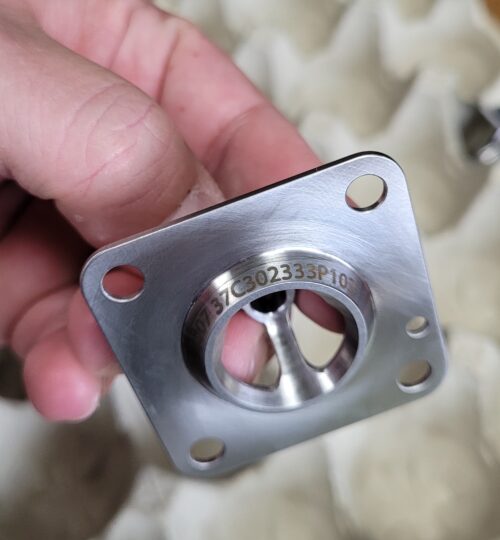
Our computerized laser marking machine is simple to program and allows us to save templates for repeat work. Those templates ensure the same marking style and positioning on every part.
The system can continue a serial number sequence from the previous part or even a previous order, and we can create fixtures that hold up to 10 parts in one setup. For repeat orders, saved programs also simplify setup and keep consistency across production runs.
These features make laser marking the best option if customers have flexibility in choosing a method.
Etching to Meet Existing Drawing Requirements
Chemical etching and electroetching are similar processes that both use chemical solutions to create a mark. They typically take more time than laser marking and can cost somewhat more, although the difference is usually small. They also involve more manual work, but careful processes help us produce clear marks.
These methods are most common on older drawings, but we’re glad to provide either one when your requirements call for it.
Vibro Peening for Traceability
Vibro peening uses a rapidly vibrating pointed tool to mark characters into a part’s surface. It was once a common marking method, though it’s used less often today. Some of the legacy aerospace parts we vibro peen have drawings dating back as far as 50 years.
In our manual vibro peening process, the operator holds the tool and forms the characters. It takes longer than laser marking and requires a steady hand for legibility. Our experienced operators have the skill to produce consistent marks for your parts.
Choose the Right Method for Your Part
If you are developing a new part or considering an approved change to an existing marking requirement, laser marking is almost always the method we’d recommend.
But if your drawing calls for an established method, we can support that requirement too. Contact us to discuss your part and its marking specifications.